Showing posts with label Jay A. Quine. Show all posts

Tuesday, November 29, 2011

How the the Apostles Die? By Dr. Jay Quine

What about those who followed after the prophets? What happened to the disciples, for instance? Here is a quick summary:

It is uncertain what happened to Matthew. He ministered in Palestine, Ethiopia, Macedonia, and in the Euphrates Persian area. Some accounts say he died a natural death, whereas others say he was executed in Persia.

After many years of ministry Peter was crucified in Rome in 67 A.D.

Andrew was likely forced to leave Jerusalem and ministered in Galatia, and then the coast of the Black Sea. He passed into obscurity.

The Apostle James was beheaded by King Herod Agrippa in A.D. 44.

John fled Jerusalem to Ephesus, but he was arrested there and finally exiled and died alone on the Island of Patmos.

Philip, was also forced to leave Jerusalem. It is unclear what happened to him. Some tradition asserts he was murdered, others say he died in obscurity.

Judas, not Judas Iscariot, together with Simon the Zealot, were executed in Persia.

Bartholomew was executed while ministering in Armenia.

Thomas became a missionary to India. No one knows exactly what happened to him.

The record for others in addition to the disciples is equally compelling.

There is strong historical tradition that Barnabas went back to his homeland of Cyprus, and continued to preach the word. But on that Island a group who opposed him killed him.

After leaving his ministry in Corinth under turmoil, the great preacher Apollos couldn’t be compelled to return even by Paul (1 Cor 16). For some reason some of the Corinthians strongly objected to his preaching and divided the church over it.

For his preaching Paul was ridiculed, laughed at, beaten, stoned, left for dead. He was ultimately arrested not once but twice and finally beheaded in the capital city of Rome.

Jesus said: “Blessed are the persecuted on account of me, for your reward in heaven is great.”

Enhanced by Zemanta

Sunday, August 14, 2011

The Waiting of All Creation, by Jay Quine

The Word "Creation" in Romans 8:19-22
She counted down the days until the wedding. Finally all the planning, all the talking, and the arrangements would come to an end. Although nervous, she and her beloved fiancé’ would be married. That picture of anticipation is painted in the Bible’s portrayal of nature waiting for the day of our redemption. All creation is waiting, even groaning for the day when you and I will be fully redeemed in a future day of glory. This is Dr. Jay Quine. In my house are three cats, a gecko lizard, a rabbit, and a dwarf hamster. They have been subjected to futility. Sin has entered the world, affecting all of creation. Remember the word, and see them and all creation waiting for the day.

Thursday, August 11, 2011

Jay Quine: Remember the Word "Alive"

Romans 6:11-13
We planted a few rows of snow peas, and beans in our flower bed. The wrinkly dry seeds looked completely dead. But with a little water, the nutrients of the soil, and the warmth of the sun, we know they will spring to life. The Bible uses this word “alive” to describe those who may not look like much, but are full of life in Christ. With the watering of the Word, the nutrient of doctrine for your soul, and the invigorating power of the Son and Spirit of God, we will spring to life. Dr. Jay Quine here to remind you of this word. You are alive. Present yourselves to God as those alive from the dead, and your members as instruments of righteousness to God. Who knows what harvest you will brings as the Lord will uses you in newness of life.

Friday, August 5, 2011

Jay A. Quine on Paul's First Missionary Journey

Saint Barnabas curing the poor by Paolo Verone...Image via Wikipedia
Jay A. Quine on Paul's First Missionary Journey

Not long after returning to Antioch the Holy Spirit sets Paul and Barnabas apart (Acts 13:1-3).  After first traveling to Barnabas' homeland of Cyprus, they sail to Pisidian Antioch (Acts 13:13-14, the coast in present south central Turkey).  They travel through the cities of Galatia establishing churches and yet being forced to leave each locale by jealous Jewish Judaisers.  After affirming each church on the return trip, Paul and Barnabas return to Syrian Antioch to winter there and report of the spread of the Gospel to their home church (Acts 14:27-28). 

Shortly after returning to his home church, Paul heard that a group of Judaisers had followed in his footsteps, adding to Paul's message of salvation and Christian living by grace through faith the requirement of circumcision and obedience to the Mosaic Law.  Paul writes them a letter (Galatians, written approximately A.D. 48) to contrast enslavement to legalism with the life of freedom the believer has in Christ. 

Because of Paul's experience ministering to Gentiles in Galatia, and fighting the inroads of Jewish legalism in his letter to them, Paul was a valuable witness in the counsel in Jerusalem centering on the issue whether Gentiles had to be circumcised and otherwise obey the Law of Moses to be saved (Acts 15).  Paul, Barnabas and those from Jerusalem were entrusted to carry the decision of the counsel to encourage the churches in other regions.
 
Dr. Jay Quine is a graduate of Dallas Theological Seminary (Th.M., and Ph.D.), the University of Idaho college of Law (J.D.), and Washington State University (B.S.).

Jay A. Quine has served as a pastor for 16 years in Texas, New Jersey, and Pennsylvania, Jay Quine has served as the Chair of the Master of Divinity Program, and Dean of the College of Biblical Studies at Philadelphia Biblical University.  Later, Dr. Jay A. Quine  served as a Professor of Bible Exposition at Dallas Theological Seminary.

Published and honored on multiple levels and in many arenas, Dr. Jay Quine is considered to be a voice of legal authority on issues involving church and para-church Christian institutions.


Conversion and Early Ministry of Paul by Jay A. Quine

The Tyche (Fortune) of Antioch. Marble, Roman ...Image via Wikipedia
Overview of the Ministry of Paul


I.  Conversion and Early Ministry

After Paul's dramatic conversion (Acts 9) he is forced to leave Damascus.  He spends three years (studying and preparing for his ministry?) in Arabia (Gal 1:17).  He then returns to Damascus (Acts 9:21-25; 2 Cor 11) and ministers the word.  He travels to Jerusalem to meet some of the elders of the church (Gal 1:16-17) and settles in his home town, Tarsus.  Recognizing the great need in Syrian Antioch for an able teacher such as Paul, Barnabas travels to Tarsus and convinces Paul to return with him to Antioch.  There Paul spends approximately 11 years (derived from the "14 years later" i.e., since his conversion, Gal 2:1) preaching and teaching before returning again to Jerusalem during a time of famine there (Gal 2:1-10; Acts 11).  He returns to his new home in Antioch.

Dr. Jay Quine is a graduate of Dallas Theological Seminary (Th.M., and Ph.D.), the University of Idaho college of Law (J.D.), and Washington State University (B.S.).

Jay A. Quine has served as a pastor for 16 years in Texas, New Jersey, and Pennsylvania, Jay Quine has served as the Chair of the Master of Divinity Program, and Dean of the College of Biblical Studies at Philadelphia Biblical University.  Later, Dr. Jay A. Quine  served as a Professor of Bible Exposition at Dallas Theological Seminary.

Published and honored on multiple levels and in many arenas, Dr. Jay Quine is considered to be a voice of legal authority on issues involving church and para-church Christian institutions.


Houston Theologian Jay A. Quine Reflects About The Epistle of Paul to the Galatians

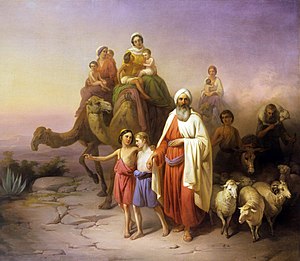
Molnár József: Ábrahám kiköltözéseImage via Wikipedia
The Epistle of Paul to the Galatians
                                                   Written from Antioch in A.D. 48

The Roman province of Galatia in modern central Turkey was visited by Paul on his first missionary journey.  He established new churches in the most populated cities of the province.  Shortly after returning to his home church, Paul heard that a group of Jews called Judaisers had followed in his footsteps, adding to Paul's message of salvation and Christian living by grace through faith the requirement of circumcision and obedience to the Mosaic Law.  Paul writes to contrast enslavement to legalism with the life of freedom in Christ. 

Chapters 1-2  Paul’s Authority Defended 
In defense of Christian liberty, Paul defends his apostolic authority.  The Galatians can trust the message they heard from Paul because he received this Gospel from Christ Himself (1:11-12).  His authority as an Apostle does not rest on men but God, even though others recognized his apostleship (2:1-10). The news of grace he delivered can be trusted (2:17-21).

Chapters 3-4  Justification by Faith Defended 
In defense of Christian liberty, Paul defends the doctrine of justification by faith.  Abraham, who was saved by faith not by works, illustrates the principle that salvation comes by grace, not by law (3:6-9).  As heirs of the promise given to Abraham, the Galatians should recognize that they have been redeemed from the principle of law (4:1-7).  Thus, since they were saved by faith, why should they return to slavery by accepting a system of works (4:21-31)?

Chapters 5-6  Sanctification by Faith Defended 
In defense of Christian liberty, Paul defends the doctrine of sanctification by faith.  Living under a legalistic code is not consistent with the grace provided by Christ (5:1-12).  To answer possible objections of licentious living under such freedom, Paul asserts that this grace life does not give freedom to sin, but to serve (5:13-15).  The grace life results in recognizable fruit of the Spirit (5:16-26), including benefits in human relationships (6:1-10).

Key Verse: Galatians 5:1 
"It was for freedom that Christ set us free; therefore keep standing firm and do not be subject again to a yoke of slavery."


Dr. Jay Quine is a graduate of Dallas Theological Seminary (Th.M., and Ph.D.), the University of Idaho college of Law (J.D.), and Washington State University (B.S.).

Jay A. Quine has served as a pastor for 16 years in Texas, New Jersey, and Pennsylvania, Jay Quine has served as the Chair of the Master of Divinity Program, and Dean of the College of Biblical Studies at Philadelphia Biblical University.  Later, Dr. Jay A. Quine  served as a Professor of Bible Exposition at Dallas Theological Seminary.

Published and honored on multiple levels and in many arenas, Dr. Jay Quine is considered to be a voice of legal authority on issues involving church and para-church Christian institutions.

 Related articles

The Gospel of Matthew Analysis by Jay A. Quine


The Gospel of Matthew
Written by Matthew, c. 44-50 AD

Matthew wrote to show unbelieving Jews in Palestine that Jesus is the promised Messiah, and King.  He also wrote to encourage those converted that although He has turned to Gentiles, the Lord has reserved a future for Israel.  Matthew’s focus is therefore the Messianic/Kingly character of Jesus while showing that as a consequence of being rejected, God now looks to Gentiles in the current administration of His program.

Chapters 1—4  Early Life and Ministry of Jesus
The genealogy (from Abraham-David-Captivity-Jesus) confirms Jesus as the promised King.  The announcement  to Joseph identifies the Child as the one who brings salvation. In His baptism, not only is He identified with John’s message of repentance, but is anointed (as kings were) by the Spirit.  Even in temptation He remains noble.

Chapters 5—9  The King Proclaims His Standards; Reveals His Authority
The King offers a heightened standard—one of nobility (5:1-16); an internal (not only demonstrable) focus; a gallant lifestyle (6:1—7:12).  Jesus then invites all to be citizens of the Kingdom (7:13-29). Punctuating his invitation, He heals the clean and unclean (8:1-22), commands the natural and supernatural (8:23—9:17), and restores life, sight, and sound (9:18-38).  His claim to forgive sin is clearly of God.

Chapters 10:1—16:12  The King and His Kingdom Offer is Rejected
Even though rejected and accused of being empowered by Satan (10:1--11:1), the King still extends peace and rest to those burdened by an oppressive religious system (11:28-30).  Through parables, Jesus explains to the disciples God’s new administration.

Chapters 16:13—20:28  The King Reveals Himself to the Disciples
After explaining that He must die, Jesus reveals His transfigured glorious state to three disciples (16—17).  He institutes administrative (church discipline) and lifestyle changes (divorce, rewards) applicable in the new administration (18—20).

Chapters 20:29—25:46  The King’s Presentation and Predictions
The King rides into His city; is rejected by the people; is challenged by the leaders.  After announcing judgment upon Israel, Jesus responds to the disciple’s questions, explaining events and circumstances leading to His return.

Chapters 26—28  The King’s Passion to the Cross and Resurrection
The trials and crucifixion demonstrate the King’s Messianic service to His people.  Yet, it is not in death but in His resurrection that His claim as King is validated.  He sends the disciples to preach the Kingdom message to the world.

Key Verse:  Matthew 11:28—30
“Come to Me, all who are weary and heavy-laden, and I will give you rest.  Take My yoke upon you, and learn from Me, for I am gentle and humble in heart; and you shall find rest for your souls, for My yoke is easy, and My load is light.”

Houston Theologian Jay A. Quine Reflects About James


Praise
As difficult as their situation is, rather than complain James tells them to control their tongues and give praise to the Lord.  Their wisdom is not demonstrated by their words, but by their deeds.

Participate
They should not be tempted to escape their hardship by returning to the old culture or embracing the world system, for a friend of the world is an enemy of God.  Rather, they must resist this temptation and submit to God who is in control.

Pray
Those who have more are not to cheat their workers.  All are to live with the expectation of the coming of the Lord of compassion and mercy.  Therefore, continue to pray, sing praises, and persevere.


Key Verse:  James 1:22 
“But prove yourselves doers of the word, and not merely hearers who delude themselves.”

 
Dr. Jay Quine is a graduate of Dallas Theological Seminary (Th.M., and Ph.D.), the University of Idaho college of Law (J.D.), and Washington State University (B.S.).

Jay A. Quine has served as a pastor for 16 years in Texas, New Jersey, and Pennsylvania, Jay Quine has served as the Chair of the Master of Divinity Program, and Dean of the College of Biblical Studies at Philadelphia Biblical University.  Later, Dr. Jay A. Quine  served as a Professor of Bible Exposition at Dallas Theological Seminary.

Published and honored on multiple levels and in many arenas, Dr. Jay Quine is considered to be a voice of legal authority on issues involving church and para-church Christian institutions.